
Yes, Gandhi Was More Hindu Than Anybody!
Introduction
In contemporary political discourse, a persistent ideological contradiction characterizes both academic and public spheres. Modern secular-liberal establishments routinely invoke Mohandas Karamchand Gandhi as the foundational architect of a deracinated, secular state apparatus, attempting to sever him from his indigenous civilizational matrix. Conversely, post-independence identity politics frequently reduce his complex philosophical trajectory to fit narrow, partisan frameworks.
However, a rigorous examination of the Collected Works of Mahatma Gandhi (CWMG), his foundational tracts such as Hind Swaraj, and his sustained reflections in Young India and Harijan reveals a vastly different paradigm. Gandhi was, by his own unequivocal formulation, fundamentally and unapologetically a Hindu. His political vocabulary, ethical imperatives, and existential methodology emerged organically from the inner metaphysics of Sanatana Dharma.
Employing an authentic Indic narrative framing, this paper examines the profound Hinduness embedded in Gandhi’s life and writings, addressing historical distortions and countering secular-left historiographical reductionism with archival evidence.
1. The Metaphysical Framework: Sanatana Dharma and the Hindu Mind
To comprehend Gandhi’s public philosophy, one must reject the secular premise that his politics operated independently of his spiritual worldview. In his autobiography, An Autobiography or The Story of My Experiments with Truth, Gandhi explicitly demonstrates that his political activism was entirely subordinate to his spiritual quest for self-realization (moksha).
Writing in Young India (October 6, 1921), Gandhi articulated his deep psychological and spiritual anchoring in Hinduism:
"I can no more describe my feelings for Hinduism than for my own wife. She moves me as no other woman in the world can... Not that she has no faults; I dare say she has many more than I see myself. But the feeling of an indescribable bond is there. Even so I feel for and about Hinduism with all its faults and limitations."
Further affirming his alignment in his essays, Gandhi defined himself not as a modern political reformer tinkering with tradition from without, but as an insider operating squarely within the Vedic framework:
"I am a sanatani (orthodox) Hindu. I believe in the Vedas, the Upanishads, the Puranas, and all that goes by the name of Hindu scriptures... I claim to be a staunch Hindu because all my ideas are derived from the traditions of Hinduism." (Young India, 6-10-'21, pp. 317-18)
Secular historiography frequently attempts to recast Gandhi’s concept of Ramrajya as a secular metaphor for a modern egalitarian welfare state. Archival analysis, however, establishes that Gandhi’s Ramrajya was profoundly theological and civilizational representing the sovereignty of divine law, moral righteousness (maryada), and ethical integrity instantiated by Bhagwan Rama. For Gandhi, Rama was not merely a literary trope, but the living, breathing sovereign of the human conscience.
2. Hind Swaraj: Civilizational Critique and Traditional Conduct (Achara)
Published in 1909, Hind Swaraj is Gandhi’s most trenchant critique of Western modernity. While leftist and post-colonial analyses frequently categorize the text solely through an anti-imperialist political lens, they often ignore its rigorous civilizational critique of industrial modernity (sabhyata) through an Indic epistemology.
In Hind Swaraj, Gandhi argues that India’s subjugation was primarily a consequence of moral and spiritual deviation from traditional ancestral conduct (achara):
"The English have not taken India; we have given it to them."
He contrasts Western civilization, which he diagnoses as diseased by materialism, hyper-urbanization, and institutionalized violence, with ancient Indian civilization, asserting:
"Nothing can equal the seeds sown by our ancestors... Civilization is that mode of conduct which points out to man the path of duty."
By equating civilization with the performance of dharma (duty), Gandhi anchored his anti-colonial resistance directly in classical Hindu philosophy. His critique of modern industrialism, centralized technology, and Western medicine drew directly from the traditional worldview of aparigraha (non-possession) and ecological restraint.
Gandhi recognized that British imperialism was merely the political manifestation of a deeper spiritual malaise — namely, the worship of mammon and material power over soul-force (satyagraha). His antidote was a conscious return to indigenous village self-sufficiency (gram swaraj), modeled on traditional civilizational patterns of decentralized cooperative living. His idea of trusteeship and socialism also drives from the Ishavasya Upanishad.
3. Non-Exclusivism Rooted in Particularism
A core tenet of the Indic intellectual framework is that true universalism (Sarva Dharma Sambhava) proceeds from a secure, deeply rooted particularism. Gandhi exemplified this axiom. His profound engagement with and respect for other religious traditions did not dilute his Hindu identity; rather, it flowed directly from the Vedantic premise of non-duality and an all-encompassing spiritual vision.
Crucially, Gandhi noted that his ability to appreciate other traditions stemmed entirely from the breadth of his own ancestral faith:
"In spite of my being a staunch Hindu I find room in my faith for Christian and Islamic and Zoroastrian teaching, and, therefore, my Hinduism seems to some to be a conglomeration and some have even dubbed me an eclectic. Well, to call a man eclectic is to say that he has no faith, but mine is a broad faith which does not oppose Christians— not even a Plymouth Brother—not even the most fanatical Mussalman. It is a faith based on the broadest possible toleration. I refuse to abuse a man for his fanatical deeds, because I try to see them from his point of view. It is that broad faith that sustains me. It is a somewhat embarrassing position I know—but to others, not to me.." (Young India, December 22, 1927)
Furthermore, Gandhi viewed heterodox and reformist movements native to India such as Buddhism not as rejections of Hinduism, but as its organic expansions. He was saturated with the best that was in Hinduism...The Buddha never rejected Hinduism, but he broadened its base."
Gandhi was also a staunch supporter of the Varnashram, the core of Hindu Society. He writes:
Though the law of varna is a special discovery of some Hindu seer, it has universal application. Every religion has some distinguishing characteristic, but if it expresses a principle or law, it ought to have universal application. That is how I look at the law of varna. The world may ignore it today but it will have to accept it in the time to come. It ordains that every one shall fulfil the law of one's being by doing in a spirit of duty and service that to which one is born. (Harijan, 28-9-'34 p. 261-62)
4. The Mother Gita and the Imprint of Ahimsa
No exploration of Gandhi’s Hinduness is complete without examining his relationship with the Bhagavad Gita. Left-liberal appropriations often attempt to sanitize Gandhi's spiritual life, reducing his ethical positions to secular humanitarianism. Yet, Gandhi himself maintained that his psychological resilience derived entirely from his daily communion with the Gita, which he elevated to the status of a mother.
Writing in Harijan (August 24, 1934), Gandhi professed:
"Today the Gita is not only my bible or my Koran; it is more than that—it is my mother. I lost my earthly mother who gave me birth long ago; but this eternal mother has completely filled her place by my side ever since. She has never changed, she has never failed me. When I am in difficulty or distress, I seek refuge in her bosom."
For Gandhi, the battlefield of Kurukshetra (Dharmakshetra) described in the Gita was an allegory for the eternal moral duel waged within the human heart between the forces of light (daivi sampad) and darkness (asuri sampad). His doctrine of ahimsa (non-violence) which he considered Hinduism's greatest and most distinctive contribution to global culture was not a strategic political gimmick, but a deeply spiritual realization rooted in the Vedantic vision of the fundamental unity of all life.
As he observed in Harijan (December 26, 1936):
"The chief value of Hinduism lies in holding the actual belief that all life (not only human beings, but all sentient beings) is one, i.e., all life coming from the One universal source.”
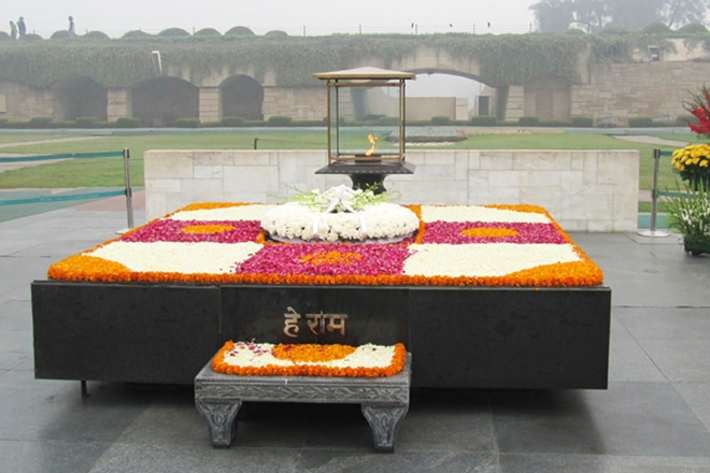
His continuous recourse to Hindu symbols his daily congregational prayer meetings, the unbroken repetition of Ramarama from his childhood nurse until his final, dying breath ("He Rama"), and his reliance on indigenous spiritual idioms proves that his inner psychological and spiritual universe was thoroughly and indelibly Hindu.
Conclusion
Gandhi’s life, writings, and archival legacy systematically dismantle the artificial binaries constructed by modern political ideologies. He was neither a sectarian fundamentalist nor a deracinated secular modernist. He was a profound product of the Indian civilizational ethos firmly rooted in Sanatana Dharma, drawing his ethical resilience, strategic vocabulary, and worldview directly from Hindu antiquity. For Gandhi, the concept of Ramarajya was not a utopian idea, but the ultimate embodiment of a moral and spiritual commonwealth—the "Kingdom of God on earth". Clarifying his vision, he frequently emphasized that Ramarajya signified the sovereignty of the people based on pure moral authority rather than coercive state power. In his articulation, Ramarajya ensured equal rights and justice for the lowest and the marginalized (antyodaya), famously noting that the Ramarajya of his dream ensures equal rights to both "prince and pauper". By invoking Bhagwan Rama, Gandhi pointed toward an ethical order governed by truth (satya), righteousness (maryada), and non-violence (ahimsa), where moral governance superseded brute force. Reclaiming Gandhi through an authentic Indic narrative frees him from secular-left reductionism and restores him to his rightful place as an uncompromising seeker whose life was an ongoing experiment anchored in the eternal truths of Hindu civilization.
Reference:
Gandhi, M. K. (1927–1929). An autobiography: The story of my experiments with truth (M. Desai, Trans.). Navajivan Publishing House.
Gandhi, M. K. (1909). Hind Swaraj or Indian Home Rule. Navajivan Publishing House.
My Hinduism is not exclusive | Mind of Mahatma Gandhi | Philosophy https://share.google/4njuFWmvAZcv4v3th
The Collected Works of Mahatma Gandhi (1 to 98 VOL), 2016.
Gandhi, M. K. (1955). My Religion (B. Kumarappa, Comp.). Navajivan Trust.


Comments